
Irish in Cheshire, Connecticut

Updated: Mar 11
The nineteenth-century history of the Irish in Cheshire, Connecticut, is a story of transformation. Over the course of one hundred years, Irish immigrants moved from the margins of town life—isolated in canal-side shanties and mining camps—to established neighborhoods where they owned property, educated their children, and participated fully in civic and religious institutions. Their ascent rested on three foundations: heavy infrastructure labor, Civil War service, and the boarding-house economy that converted domestic work into migration capital.
I. Foundations in Labor: Canal and Copper, 1825–1848

Irish settlement in Cheshire accelerated with construction of the Farmington Canal, built between 1825 and 1848 to link New Haven with the Connecticut River. Hundreds of Irish men supplied the muscle that carved the channel by hand. They lived in rough, one-room wooden huts—“shanties”—clustered along the route. Dirt floors, minimal ventilation, and seasonal exposure defined daily life.
At the same time, Irish labor sustained Cheshire’s copper industry, including
operations such as Peck’s Mining Company. Miners descended into damp shafts and endured the heat and fumes of smelting raw ore. Canal digging and copper mining were physically punishing and socially isolating, reinforcing the community’s early status as transient laborers rather than townspeople.
Yet within these camps emerged an economic strategy that proved decisive. Many laborers were single men; married Irish women turned their cabins into boarding houses, cooking, laundering, and renting beds—sometimes to a dozen or more men. This “boarding-house system” generated savings used to finance passage for relatives in Ireland, creating chain migration networks that stabilized the population and strengthened kinship ties.
II. War and Legitimacy: 1861–1865
The Civil War marked a turning point. Enlistment in the Union Army allowed Irish immigrants to

recast themselves from outsiders to patriots. Men from Cheshire families—Beirne, Gillen, Nolan, and others—joined the 9th Connecticut Volunteer Infantry, widely known as the “Irish Regiment.” They served in Louisiana and Mississippi, including the Siege of Siege of Vicksburg.
Military service carried financial as well as symbolic value. Federal and local “bounties,” ranging from $100 to $700, represented unprecedented sums for families who had lived in shanties. These payments, along with back
pay and later pensions, seeded land purchases and home construction in the postwar years.
Veteran status also altered social standing. Membership in the Grand Army of the Republic provided entrée into civic networks previously dominated by Cheshire’s Yankee elite. War service functioned as a bridge—opening access to steadier employment, credit, and public respect.
III. From Canal to Rail: Permanent Settlement, 1848–1890

When the canal failed financially, its towpath became the bed of the New Haven and Northampton Railroad—the “Canal Line.” Many of the same Irish laborers who had dug the ditch laid the tracks. This continuity of infrastructure work coincided with a decisive shift: laborers became residents.
West Cheshire, especially “The Junction,” emerged as an Irish hub. With railroad wages and war bounties, families purchased modest parcels and built frame houses—often in the folk Victorian style—along streets such as
Willow Street. Property ownership signaled permanence and investment in the town’s future.
Religious life anchored this settlement. Mass was first celebrated in private homes before the formal establishment of St. Bridget of Sweden Parish. The parish provided sacramental continuity, education, and a social center that reinforced communal cohesion while integrating the Irish into Cheshire’s institutional fabric.
IV. The Trolley Era and Regional Mobility, 1890–1924

By the turn of the twentieth century, electrified transit reshaped daily life. The trolley line linking
New Haven and Waterbury ran through Cheshire along Route 10, tying the town to regional industry. Irish men increasingly moved from unskilled track labor into skilled positions as motormen and conductors.
The trolley’s geographic freedom allowed families to retain Cheshire’s rural stability while commuting to higher-paying factory jobs in Waterbury’s brass mills. Physical isolation—once a defining feature of canal camps—gave way to economic mobility. Irish residents became civic participants, business owners, and neighborhood leaders.
V. The 1870 Federal Census: A Community in Transition
The 1870 Federal Census captures the Irish of Cheshire at mid-transition, just after the war and during the railroad’s ascendancy. Surnames such as Beirne, Gillen, Nolan, Doolan, Cunningham, Keena (Keeney), Larkin, O’Neil, Sullivan, and Moran appear frequently, often with occupations listed as railroad laborer, copper miner, farm laborer, or factory hand.
Two geographic concentrations stand out:

West Cheshire (The Junction): Strings of Irish surnames along Willow and Main Streets near the depot reflect clustered settlement and mutual support.
Mixville: Families connected to manufacturing shops and nearby mines formed a secondary enclave in the western hills.
Several census patterns reveal deeper change:
Keeping House. Many Irish women are listed as “Keeping House.” Household rosters showing

unrelated young men indicate that boarding continued, though now within permanent dwellings rather than shanties. Domestic labor remained a crucial economic engine.
Agricultural Shift. By 1870, some first-generation laborers had become farmers with real estate valued between $500 and $2,000—clear evidence of capital accumulation and land acquisition.
Literacy and Schooling. While older immigrants were sometimes marked “Cannot
Read/Write,” their Connecticut-born children were typically recorded as attending school. Education became the pathway to second-generation advancement.
VI. Veterans in the Ledger
Though the 1870 census contains no column for military service, cross-referencing with regimental rolls and the 1890 Veterans Schedule identifies numerous veterans in their postwar prime.
Patrick Beirne (Co. B): Listed as a laborer in 1870, part of a family that moved from railroad-adjacent housing into permanent West Cheshire homes.
Martin Burke (Co. B): Among the “Cheshire Ten” who departed in 1862; bounty funds likely stabilized his household during the postwar downturn.
Farrell Brennan (Co. B): A survivor of Louisiana campaigns, continuing railroad labor reminiscent of his canal work.
The Gillen and Nolan families appear in multi-household clusters, suggesting pooled resources to purchase adjacent plots near the rail junction.
Subtle census clues reflect wartime impact:
Personal estate values of $100–$500 among day laborers often indicate retained bounty money or pension income.
Widowed heads of household—Margaret or Bridget listed without husbands—frequently correspond to federal war pensions.
Men “At Home” or without occupation in their thirties or forties may have carried lingering illness or injury from Southern service.
VII. The “Cheshire Ten”

Ten men identified as departing Cheshire for Vicksburg in 1862—Martin Burke, Farrell Brennan, John Dawson, George Hoey, John Lynch, Alexander Mercier, William Moon, Charles Mulvey, John Mulvey, and Michael Reynolds—symbolize the community’s collective leap from marginality to recognition. Many reappear in the 1870 and 1880 records as householders embedded in the town’s economic life.
Conclusion
Across the nineteenth century, the Irish of Cheshire advanced through labor, war, and disciplined household economies. Canal digging and copper mining established their presence; Civil War service conferred legitimacy and capital; railroad expansion and trolley transit secured permanence and mobility. By 1920, the descendants of shanty dwellers occupied established neighborhoods, worshiped in their own parish, commuted to skilled employment, and educated a new generation. The transformation was neither sudden nor effortless, but it was enduring—reshaping both the Irish community and the town they came to call home.
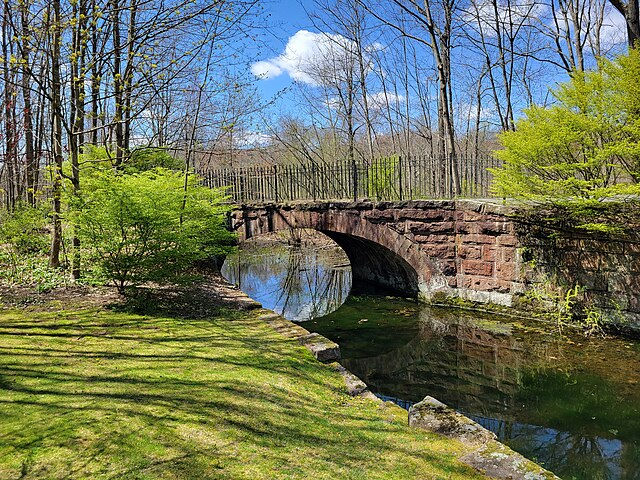


Farmington Canal Cheshire https://portal.ct.gov/-/media/DEEP/outdoor_recreation/greenways/TrailsSymposium/CheshireLinearTrailPowerPoint171018pdf.pdf
https://www.nps.gov/vick/learn/historyculture/connecticut-state-memorial.htm Vicksburg National Military Park, Connecticut State Memorial
"Admiral Andrew Hull Foote (1806–1863) was a New Haven-born Union naval flag officer during the Civil War. He attended school in Cheshire and is historically linked to the 9th Regiment Connecticut Volunteer Infantry (the "Irish Regiment") through shared Civil War memorials and regional heritage in New Haven and Cheshire. [1, 2, 3, 4, 5]"
Cheshire Civil War Monument
https://www.nationalwarmemorialregistry.org/memorials/cheshire-civil-war-memorial/